Hands-on cyber range development.
Operation Peak Defense is an isolated wireless cyber range designed and developed for controlled offensive-security training, defensive monitoring, incident response, and structured red-team/blue-team exercises.
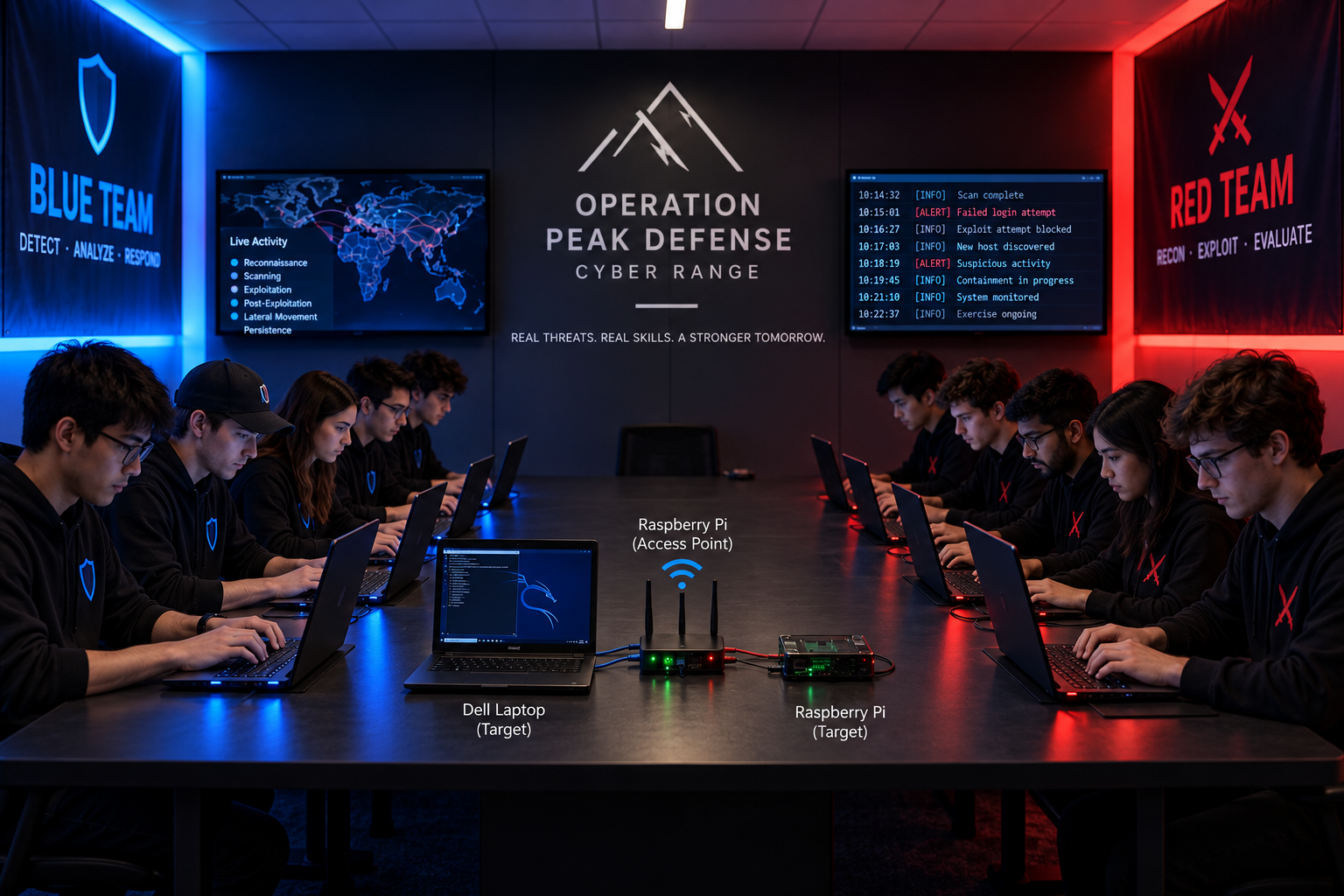
Conceptual visualization of Operation Peak Defense.
Project Overview
Operation Peak Defense is a hands-on cybersecurity training environment created to support controlled attack simulation, defensive monitoring, incident response, networking, and technical skill development. The project combines purpose-built network infrastructure, Windows and Linux systems, virtualization, security tooling, and documented operating procedures into a repeatable training platform.
Role
Project Lead / Cyber Range Designer
Focus Areas
Network Security · Offensive Security · Defensive Security · Incident Response · Cyber Range Development
Environment
Isolated wireless network · Windows target systems · Kali Linux · Raspberry Pi · VMware
Core Technologies
Nmap · Wireshark · OpenSSH · SMB · Windows Event Viewer · Windows Admin Center · Linux · Windows
What I Built
Operation Peak Defense was designed as a self-contained cyber range where participants can practice offensive and defensive security techniques in a controlled environment. The battle configuration places two opposing teams across from one another, with each participant working from an individual laptop while the shared range infrastructure remains centered between the teams.
Wireless Range Infrastructure
A dedicated Raspberry Pi functions as the wireless access point for the isolated training network, keeping battle traffic separate from normal internet-connected devices.
Primary Target Systems
A dedicated Windows laptop and a separate Raspberry Pi provide controlled target systems for reconnaissance, enumeration, exploitation, detection, and response exercises.
Participant Systems
Team members operate from their own laptops using prepared cybersecurity environments such as Kali Linux virtual machines and approved security tools.
Red Team / Blue Team Workflow
The environment supports structured attack-and-defense exercises in which offensive participants identify and exploit approved weaknesses while defensive participants monitor activity, investigate events, contain access, remediate issues, and verify recovery.
Architecture & Security Design
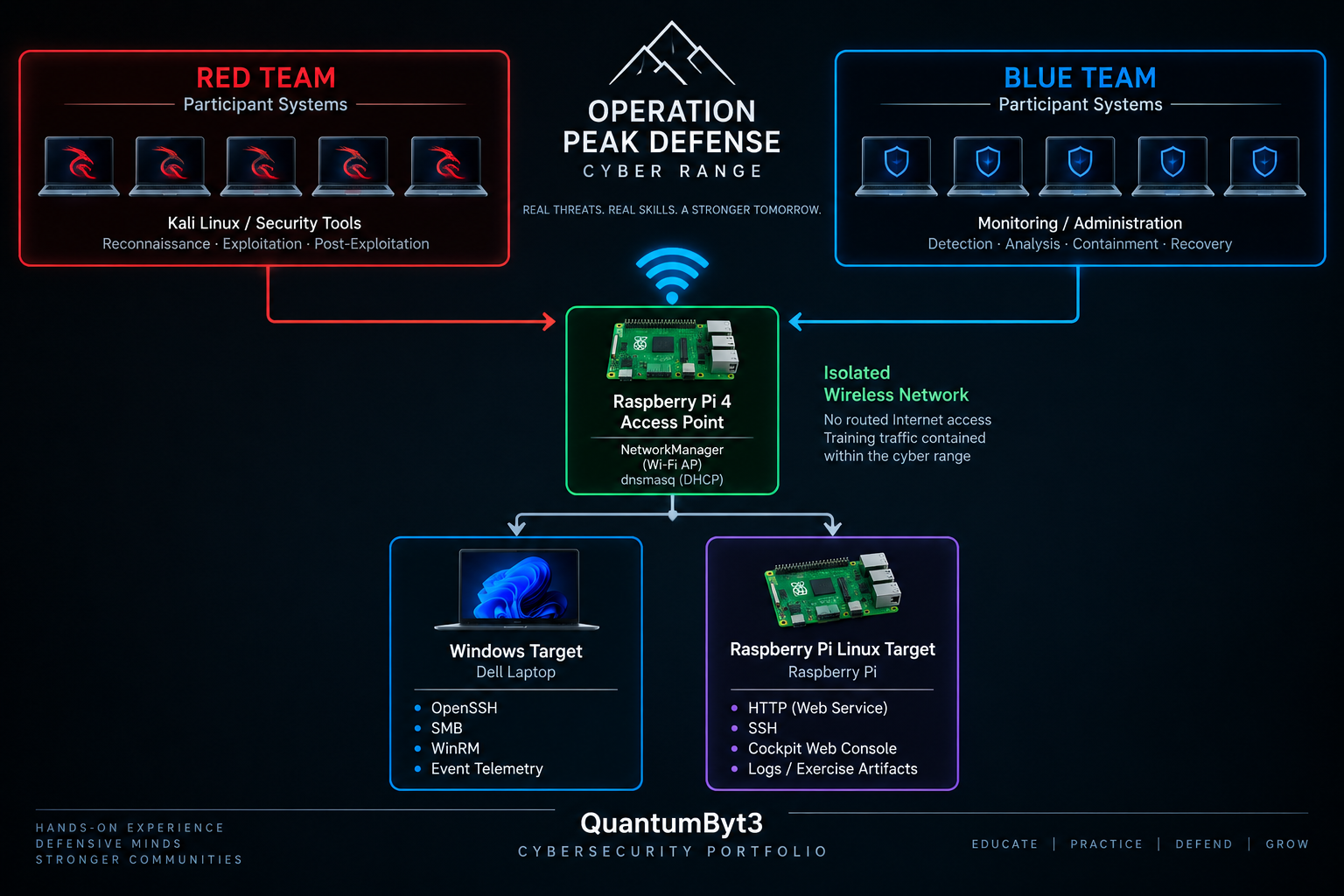
Operation Peak Defense uses a deliberately isolated architecture designed around containment, repeatability, observability, and controlled access. The environment combines a dedicated wireless access point, Windows and Linux targets, participant-owned systems, and defined Red Team/Blue Team workflows to support realistic hands-on exercises without exposing external networks.
Isolated Wireless Range
A dedicated Raspberry Pi 4 provides the isolated wireless battle network. NetworkManager manages the wireless access-point configuration, while dnsmasq provides local DHCP services for participating systems. The range is intentionally separated from normal internet-connected activity so exercise traffic remains contained within the authorized training environment.
Windows Target
A dedicated Dell Windows system provides the primary Windows attack-and-defense target. The host exposes controlled services including OpenSSH, SMB, and WinRM, allowing Red Team participants to perform authorized reconnaissance and access exercises while Blue Team participants monitor activity through Windows Event Viewer and perform remote management and containment through Windows Admin Center.
Raspberry Pi Linux Target
A separate Raspberry Pi serves as the dedicated Linux target. The system hosts an HTTP web service, SSH access, and Cockpit Web Console, along with user accounts, logs, files, and exercise artifacts that support Linux-focused enumeration, access, monitoring, administration, and response scenarios. This gives participants experience working against and defending a second operating-system platform rather than relying only on the Windows target.
Participant Systems
Red Team and Blue Team participants operate from their own prepared laptops, using approved security environments such as Kali Linux virtual machines and defensive administration tools. During live exercises, the two teams work from opposite sides of the room while the shared access point and target systems remain centrally positioned and controlled.
Red Team / Blue Team Workflow
Operation Peak Defense supports controlled attack-and-defense exercises that move from discovery through response and recovery.
Red Team
Participants perform authorized reconnaissance, enumeration, initial access, and exploitation against designated targets using approved tools and defined rules of engagement.
Blue Team
Participants monitor system activity, investigate events, contain unauthorized access, remediate affected accounts or services, and verify recovery using Windows and Linux administration tools.
Exercise Flow
Reconnaissance → Access → Detection → Containment → Remediation → Verification
Skills Demonstrated
Cyber Range Engineering
Designed and integrated isolated network infrastructure, target systems, and participant environments.
Network Security
Implemented segmented wireless infrastructure and controlled network services for authorized exercises.
Offensive Security
Applied reconnaissance, enumeration, access, and exploitation techniques within defined rules of engagement.
Defensive Security
Monitored activity, investigated events, contained access, remediated systems, and verified recovery.
Windows & Linux Administration
Configured, managed, and monitored both Windows and Linux target environments.
Technical Leadership
Coordinated the design, documentation, training workflow, and execution of a multi-user cybersecurity project.
Outcome: Built a repeatable hands-on environment that connects cybersecurity theory with practical attack, defense, administration, and incident-response experience.